














Key Takeaways
- Lupus is an autoimmune disease in which your immune system attacks healthy tissues and organs. It can affect the joints, skin, heart, kidneys, brain, lungs, and other body systems.
- Common symptoms include fatigue, painful or swollen joints, a butterfly-shaped rash on the face, photosensitivity, and cognitive dysfunction (often called brain fog). Around 95% of people with lupus experience joint symptoms during their lifetime.
- Lupus can lead to serious complications such as kidney disease (lupus nephritis), heart conditions like pericarditis or coronary artery disease, anemia, and lung inflammation. Treatment focuses on managing symptoms and preventing organ damage.
Lupus is an autoimmune disease that causes your body’s immune system to attack healthy tissues and organs instead of only attacking foreign substances.
The disease can cause widespread damage to different areas of the body, including the joints, skin, heart, blood vessels, brain, kidneys, bones, and lungs.
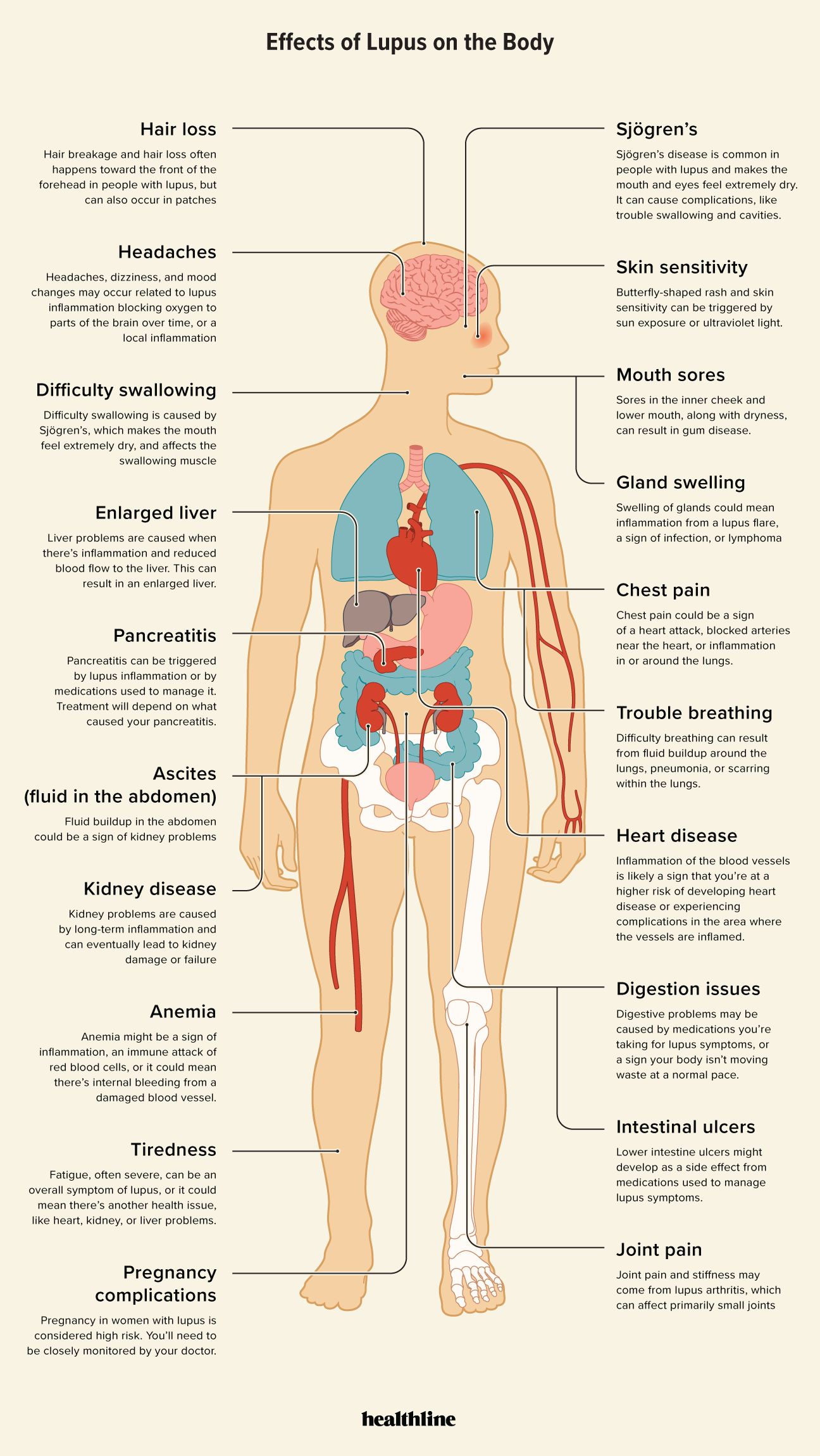
There are four different kinds of lupus, each with slightly different triggers and symptoms.
Researchers don’t know exactly what causes lupus, but it seems to run in families and may have a connection to estrogen and other hormones. Environmental triggers may also cause the condition to develop or worsen.
No matter the lupus type, there are some symptoms that are common in everyone with the condition. These include:
- fatigue
- recurrent oral ulcers
- painful, swollen joints
- swelling around the eyes
- swollen hands and feet
- headaches
- low grade fever
- light sensitivity
- chest pain when breathing deeply
Many people with lupus experience skin symptoms that can vary by disease type and activity.
One symptom is a malar rash, most commonly characterized by discoloration of the bridge of the nose and the cheeks. The rash’s shape can resemble a butterfly, which is why it’s sometimes called a butterfly rash. However, it can also appear on the arms, legs, or other parts of the body.
Around 40% to 70% of people with lupus experience worsening symptoms when exposed to sunlight or some forms of artificial ultraviolet (UV) light. This is known as photosensitivity.
Photosensitivity can cause discolored, itchy skin patches in areas of the body exposed to UV light, such as on the scalp, face, neck, or arms.
UV light exposure can also trigger general lupus symptoms, such as:
- fatigue
- tingling
- numbness
- joint pain
Sometimes, ulcers or sores, similar to canker sores, can form on the inner cheeks or gums. They can occur with lupus itself, or as a side effect of certain medications that may be used to treat the disease.
Sjogren disease is another autoimmune condition that some people with lupus may experience, with some studies suggesting that up to 20% of people with Sjögren disease also have lupus.
Sjögren disease causes your mouth to feel very dry, which may make it difficult to speak or swallow. Dry mouth can also put you at a higher risk of cavities, because saliva usually helps protect your teeth from bacteria.
However, Sjögren disease can often present with systemic symptoms in addition to dryness. Among around 6,300 respondents, the top five symptoms were dry eyes, dry mouth, fatigue, joint pain, and brain fog. More than half of the top 20 symptoms were not dryness-related.
Some people with lupus may experience hair loss or dry or more brittle hair. This can be due to lupus or the medications that treat it, such as immunosuppressants or steroids.
Hair may break or fall out, particularly at the front of the head and around the forehead. It may grow back, but sometimes it can leave permanent bald spots, particularly if you have scalp scarring from lupus-related skin conditions.
Having lupus can affect your heart and blood vessels, and around 50% of people with lupus experience heart complications. In fact, females aged 35 to 44 years who have lupus are more than 50 times more likely to experience a heart attack than those of a similar age without lupus.
Heart conditions that may be linked to lupus include:
- Coronary heart disease (also known as coronary artery disease): If the coronary arteries become partially blocked, it can cause dull chest pain when exercising. The pain usually disappears quickly when at rest. A total arterial blockage can lead to a heart attack. Coronary artery disease may include symptoms such as leg swelling, breathlessness, and less frequent urination.
- Pericarditis: The pericardium is the thin, fluid-filled sac that surrounds your heart. When the pericardium becomes inflamed, it is known as pericarditis. Common symptoms include a rapid heartbeat (tachycardia), chest pain, and breathlessness.
- Myocarditis: The myocardium is the heart’s middle muscular layer. When this muscle becomes inflamed, it is known as myocarditis. Common symptoms include fever, breathlessness, irregular heartbeat, or palpitations. Without treatment, the heart muscle might not pump blood as well as expected, leading to heart failure.
- Heartbeat irregularities (arrhythmias): An irregular heartbeat can lead to palpitations, fatigue, and fainting.
- Valve irregularities: You may not notice any symptoms of valve irregularities, but they can lead to a heart murmur, which a doctor can hear by listening to the heart. Symptoms can include breathlessness, heart palpitations, cough, and sometimes heart failure.
Anemia and lupus
Anemia is seen in around 50% of people with lupus over the duration of the condition. Anemia happens when the body has fewer red blood cells than usual, and for people with lupus, this can be due to inflammation, bleeding, or the immune system attacking them.
A condition that is often referred to as “brain fog” occurs in around 70% to 80% of people with lupus over their lifetime. The medical term for this is cognitive dysfunction.
If lupus affects the central nervous system (CNS) it is sometimes called CNS lupus or neuropsychiatric lupus. Symptoms of CNS lupus may include:
- confusion, difficulty concentrating, or feeling like you have brain fog
- seizures
- stroke
A chronic pain disorder, fibromyalgia,
Fibromyalgia causes:
- fatigue
- muscle and joint pain
- dry mouth and eyes
Additionally, headaches that feel like migraine, often called lupus headaches, can be caused by lupus’s effects on the central nervous system.
Around 40% to 60% of people with lupus experience gastrointestinal symptoms, with the condition itself and some lupus medications causing digestive side effects.
The most common gastrointestinal conditions in lupus are gastritis and peptic ulcer disease, which may be due to nonsteroidal anti-inflammatory medications (NSAIDs) or corticosteroids. Symptoms may include nausea, vomiting, diarrhea, and constipation, although these can also be symptoms of
Lupus mesenteric vasculitis (LMV)
Lupus can also cause lupus mesenteric vasculitis (LMV). The condition has been known to occur in up to
Liver inflammation and lupus
The liver helps with digestion and filters waste from the blood, and it can also be affected by lupus inflammation and lupus medications. When inflammation affects the liver, it is known as hepatitis. People may not notice symptoms, but if they do, they may experience:
- fatigue
- jaundice (yellowing of the eyes and skin)
- nausea
- vomitting
- abdominal pain
- dark pee
- gray or pale stool
When hepatitis is due to lupus, doctors refer to the condition as autoimmune hepatitis because your immune system attacks the liver. The two types of autoimmune hepatitis are:
- Type 1: This type is more common and affects people of all ages.
- Type 2: This type is less common and typically affects females between the ages of 2 and 14.
Doctors typically prescribe steroid medications for autoimmune hepatitis, but they may also prescribe the medications azathioprine (Imuran/Azasan) or mycophenolate (CellCept) to calm your immune system.
Inflamed pancreas
Although rare, lupus can cause inflammation of the pancreas, called pancreatitis, either from inflamed blood vessels or medications, like steroids or immunosuppressants.
The pancreas is a gland behind the stomach that controls digestive enzymes and hormones that regulate how your body processes sugar. If it does not work properly, you may be at risk of infection, digestive symptoms, and diabetes.
During their lifetime, 95% of people with lupus experience joint symptoms. This could be either arthritis, characterized by joint pain, swelling, and other symptoms, or arthralgia, characterized by joint pain without swelling.
In lupus, the lining of the joints can become inflamed, known as synovitis. This can lead to joint tenderness, swelling, and stiffness.
Lupus arthritis most commonly affects smaller joints, such as those in the hands and wrists, but can also affect larger joints, such as the knees and hips, although this is less common. It can also affect the tendon sheath, especially in the hands, leading to tendonopathy or tendonitis.
Lupus inflammation can affect the lungs, lung lining, lung blood vessels, and the diaphragm.
Inflammation and fluid buildup in or around the lungs can create a variety of complications for people with lupus, including:
- pleurisy, which is pain caused by inflammation of the outer lining of the lungs
- pneumonitis or interstitial lung disease (ILD), which is inflammation within the lung tissue
- blood clots in the lungs
- lung scarring
Females with lupus usually give birth to healthy babies, but they may need additional care from their doctor during the pregnancy.
Although lupus doesn’t directly affect the reproductive organs, the condition can increase the risk of pregnancy complications.
A pregnancy with lupus may require more frequent doctor’s visits for monitoring. Risks include:
- blood clots
- kidney disease
- high blood pressure, which can lead to preeclampsia
- baby growth becoming too slow
- premature birth
- miscarriage
- stillbirth
It’s also possible for a baby to be born with neonatal lupus syndrome, a condition that affects the heartbeat and causes a rash. However, there is a specific antibody for this that a doctor would look for to assess the risk.
You may need to change medications before you become pregnant, so it’s important to discuss any intended pregnancy with a doctor.
Your kidneys are extremely important for maintaining good health. They help remove waste from the blood, regulate blood volume and pressure, and filter waste through urine.
Kidney disease is common in people with lupus, often caused by long-term kidney inflammation. Specifically, lupus can cause a kidney disease called lupus nephritis, in which kidney inflammation can prevent the kidneys from working properly.
Lupus nephritis is most common in those between the ages of 20 and 40, and usually starts within 5 years of the first lupus symptoms.
Symptoms of lupus nephritis may only become evident as the disease progresses, but may include:
- foot, ankle, leg, or facial swelling
- foamy pee
- peeing more often than usual, particularly at night
- high blood pressure
While lupus can cause symptoms throughout the body, you may not experience all of them.
Your individual symptoms and their severity will depend on the type of lupus you have and other factors, such as the length of time you’ve had the condition.
If your lupus is well-controlled, you may have very mild symptoms, allowing for a great quality of life.