Key takeaways
- Stelara dosage depends on the condition being treated, your weight, and other factors.
- Doses are typically given via subcutaneous (under the skin) injections. Exceptions are the starting doses for Crohn’s disease and ulcerative colitis, which are administered via intravenous (IV) infusion by a healthcare professional.
- Most people receive starting doses at Week 0 (the first day of treatment) and Week 4, followed by maintenance doses every 8 or 12 weeks.
- Important safety considerations include avoiding the needle cover if you have a latex allergy, storing Stelara in the refrigerator without freezing or shaking it, and calling your doctor if you miss a dose or take too much.
Stelara is a prescription medication that’s given by injection to treat the following conditions: plaque psoriasis, psoriatic arthritis, Crohn’s disease, and ulcerative colitis.
The active ingredient in Stelara is ustekinumab. Stelara belongs to a group of drugs called biologics. A biologic drug is made from living cells.
Your dosage of Stelara will depend on several factors, including:
- the condition being treated
- your body weight
- your age
- other medical conditions that you may have
- the form of Stelara you receive
A doctor will determine the best dosage and form of Stelara for your individual needs.
Stelara comes in two forms:
- a liquid for subcutaneous injection (under the skin)
- a liquid for a one-time intravenous (IV) infusion
Subcutaneous injection doses can be given at home by the person using Stelara.
A one-time IV infusion dose of Stelara is used only for Crohn’s disease and ulcerative colitis and must be given by a healthcare professional, typically at a medical facility.
Stelara strengths
For the subcutaneous injection form, Stelara is available in:
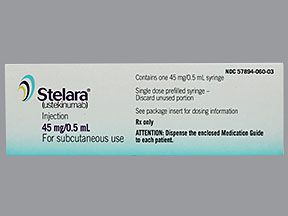
- a 45 milligram/0.5 milliliter (45 mg/0.5 mL) single-dose prefilled syringe
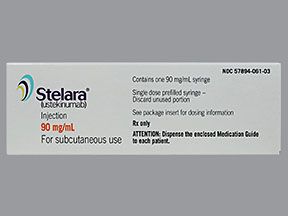
- a 90 mg/mL single-dose prefilled syringe
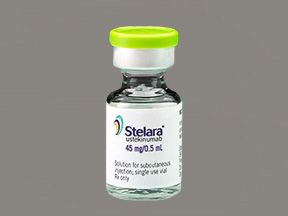
- a 45 mg/0.5 mL single-dose vial
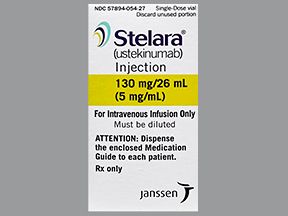
For the IV infusion form, Stelara is available only in a 130 mg/26 mL (5 mg/mL) single-dose vial.
Your doctor will decide your dose based on the condition being treated and your weight.
Note: For convenience, patient body weight is specified in both kilograms (kg) and pounds (lb) below. One kg equals approximately 2.2 lb.
Plaque psoriasis
For adults with moderate to severe plaque psoriasis, the Stelara dosing schedule is usually a subcutaneous injection at “Week 0,” “Week 4,” and every 12 weeks thereafter.
- If you weigh 100 kg (220 lb) or less: 45 mg per dose.
- If you weigh more than 100 kg (220 lb): 90 mg per dose.
Psoriatic arthritis
The dose of Stelara for adults with psoriatic arthritis is a 45-mg subcutaneous injection given at Week 0 and Week 4, then once every 12 weeks.
If you have both psoriatic arthritis and moderate to severe plaque psoriasis and you weigh more than 100 kg (220 lb), your doctor may prescribe a 90-mg dose for all injections instead.
Crohn’s disease and ulcerative colitis
Treatment for Crohn’s disease and ulcerative colitis begins differently. If you are prescribed Stelara for these conditions, you’ll receive your first dose via IV infusion by a healthcare professional. This will help the medication work more quickly at the start of your treatment.
| Adult’s body weight | Starting (loading) dose |
|---|---|
| 55 kg (121 lb) or less | 260 mg |
| 55 kg to 85 kg (121 lb to 187 lb) | 390 mg |
| More than 85 kg (187 lb) | 520 mg |
After your initial dose is given by IV infusion, you’ll switch to the subcutaneous form of the drug. The maintenance dosage is one 90-mg injection every 8 weeks, regardless of your body weight.
Stelara is approved for children ages 6 and older for plaque psoriasis and psoriatic arthritis. The dose is calculated by weight (0.75 mg of Stelara per 1 kg of the child’s weight). Your child’s doctor will determine the proper dose.
| Child’s body weight | Recommended dose | Schedule |
|---|---|---|
| Less than 60 kg (132 lb) | 0.75 mg/kg | Week 0, Week 4, then every 12 weeks |
| 60 kg to 100 kg (132 lb to 220 lb) | 45 mg | Week 0, Week 4, then every 12 weeks |
| More than 100 kg (220 lb) | 90 mg | Week 0, Week 4, then every 12 weeks |
Medical Perspective“Taking higher doses of a drug doesn’t necessarily make it more effective. Everyone has an ideal dose that works for them. For some people, taking higher doses of a drug can lead to side effects rather than therapeutic effects.”
Learn more: Possible Stelara side effects
Quotes represent the opinions of our medical experts. All content is strictly informational and should not be considered medical advice.
When indicated, a healthcare professional will administer the starting IV infusion dose of Stelara in a medical setting, such as at a doctor’s office or clinic. The infusion visit takes at least 1 hour.
Most people taking Stelara receive it as a subcutaneous injection. Your doctor may be able to teach you or your caregiver how to administer Stelara injections, allowing you to self-inject your doses at home. If your child is receiving subcutaneous injections of Stelara, it’s recommended that a healthcare professional administer their doses.
You can inject Stelara into your upper arm, buttocks, upper thigh, or abdomen. It’s important to rotate your injection sites. Rotating injection sites means injecting Stelara at a different approved injection site on your body than where you injected the previous dose.
Do not inject Stelara into skin that is red or discolored, hard, tender, or bruised.
For more information about how to inject Stelara, see the manufacturer’s step-by-step instructions.
How long is the treatment with Stelara?
Stelara is typically used as a long-term treatment. If you and your doctor determine that Stelara is safe and effective for you, you’ll likely receive it long term.
Here are a few important safety considerations to be aware of if you choose to give yourself Stelara injections at home:
- Latex allergy: The needle cover on the prefilled syringe contains dry natural rubber (latex). Do not handle it if you are allergic to latex.
- Missed dose: If you miss a dose, call your doctor right away to find out when to take your next injection.
- Storage: Store Stelara in the refrigerator. Do not freeze it or shake the vials/syringes.
- Follow the directions: Be sure to carefully read and follow the official “Instructions for Use” provided with the medication.
If you remain unsure how to give yourself an injection of Stelara, or you have other questions about the medication or its effects, see Stelara’s prescribing information or talk with your doctor or pharmacist.
If injecting Stelara at home, do not use more than your doctor prescribes. Doing so can lead to serious side effects.
Call your doctor right away if you think you’ve received too much Stelara. You can also call 800-222-1222 to reach America’s Poison Centers or visit its Poison Help website. But if you have severe symptoms, call 911 (or your local emergency number) immediately or go to the nearest emergency room.
Stelara (ustekinumab) is a prescription medication given by injection. The dose depends on your weight and the condition being treated. For most people, Stelara is started with a few initial doses, followed by maintenance doses every 8 to 12 weeks. Adults with Crohn’s disease or colitis receive their first dose via an IV infusion given by a healthcare professional. Subsequent doses can be self-injected at home under the skin.
Disclaimer: While Healthline strives for factual, comprehensive, and current information, this article is not a substitute for a licensed healthcare professional’s expertise. Always consult a doctor before taking or discontinuing any medication. Drug information is subject to change and may not cover all uses, directions, precautions, warnings, interactions, reactions, or adverse effects. The lack of a warning does not guarantee a drug’s safety, effectiveness, or appropriateness for all patients or specific uses. Learn more about our approach to content integrity.