Key takeaways
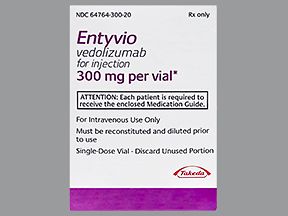
- Entyvio (vedolizumab) is a prescription drug used to treat Crohn’s disease and ulcerative colitis. Its mechanism of action (how it works) is to block specific inflammatory cells from entering the gut.
- Entyvio comes in two forms: a prefilled pen and a single-dose vial for intravenous (IV) infusion. With the pen, Entyvio is given as a subcutaneous injection (under the skin).
- Common Entyvio side effects include headache, nausea, joint pain, and fatigue. If you experience any persistent or severe side effects during treatment, your doctor can recommend safe ways to manage them.
Entyvio is used in adults to treat Crohn’s disease and ulcerative colitis (UC), which are both types of inflammatory bowel disease (IBD). See the “What is Entyvio used for?” section for more information.
Entyvio basics
Entyvio contains the active ingredient vedolizumab. It belongs to a drug class called integrin receptor antagonists.
Entyvio is a biologic medication, which means it’s made from parts of living organisms. It’s available only as a brand-name drug. It isn’t available in a biosimilar form. (Biosimilars are like generic drugs. But unlike generics, which are made for nonbiologic drugs, biosimilars are made for biologics.)
Note: This article is based on United States prescribing information. Outside of the United States, Entyvio dosages and forms may vary.
The following lists describe some of the more common side effects of Entyvio, but they don’t include all possible side effects of the drug.
Mild side effects
Mild side effects of Entyvio that have been reported include:
- headache
- runny nose
- nausea
- fatigue
- fever
- upper respiratory infection, such as a cold
- bronchitis
- back pain
- cough
- influenza (flu)
- skin side effects, such as rash or itchiness
- injection site reactions, such as swelling or bruising (if you’re receiving the form of Entyvio that’s injected under your skin)
- joint pain (see “Side effect focus” for more information)
Mild side effects of many drugs may go away within a few days to a couple of weeks. But if they become bothersome, talk with your doctor or pharmacist.
To learn about other mild side effects, talk with your doctor or pharmacist, or read Entyvio’s prescribing information.
Serious side effects
Serious side effects from Entyvio can occur, but they aren’t common. If you experience serious side effects, call your doctor right away. But if you think you’re having a medical emergency, call 911 or your local emergency number.
Serious side effects of Entyvio that have been reported include:
- infusion reaction or injection site reaction
- liver problems, such as liver damage
- serious infections, including:
- tuberculosis (TB)
- giardiasis (an infection in the small intestine)
- cytomegaloviral colitis (inflammation of the colon caused by cytomegalovirus)
- listeria meningitis (inflammation of the lining of the brain and spinal cord caused by listeria)
- sepsis (a life threatening response to an infection)
- progressive multifocal leukoencephalopathy (PML), which is a serious viral brain infection (see “Side effect focus” for more information)
- allergic reaction (see “Side effect focus” for more information)
Allergic reactionSome people may have an allergic reaction to Entyvio.
In general, symptoms of allergic reaction can be mild or serious and can occur after any dose of Entyvio.
If you have mild symptoms of an allergic reaction, such as a mild skin rash, call your doctor right away. They may suggest a treatment to manage your symptoms and can determine whether you should keep taking Entyvio.
If you have symptoms of a severe allergic reaction, such as swelling or trouble breathing, call 911 or your local emergency number right away. Or if you’re receiving an infusion, tell your healthcare professional right away. These symptoms could be life threatening and require immediate medical care.
If your doctor confirms you’ve had a serious allergic reaction to Entyvio, they’ll likely have you switch to a different treatment.
Costs of prescription drugs can vary depending on many factors including what your insurance plan covers and which pharmacy you use.
If you have questions about how to pay for your prescription, talk with your doctor or pharmacist. You can also visit the Entyvio manufacturer’s website to see their support options. And for more information, you can refer to this Entyvio cost article.
Entyvio belongs to a drug class called integrin receptor antagonists. It works by blocking the effects of integrin (a type of protein).
Integrin causes white blood cells responsible for inflammation to enter your digestive tract. It’s thought that people with inflammatory bowel disease (IBD) have an overactive immune system, which causes inflammation.
The exact mechanism of action of Entyvio in treating IBD isn’t known. It’s believed that by blocking integrin, Entyvio reduces inflammation in your digestive tract.
Entyvio is an immunotherapy medication. This means it works with your immune system to treat your condition. It isn’t a systemic immunosuppressant. (Systemic drugs affect your whole body.) Entyvio has a selective effect on your gut. It doesn’t affect your entire immune system.
If you’d like to know more about how Entyvio works for your condition, ask your doctor for details.
The manufacturer of Entyvio provides some reviews from people who’ve taken this drug. You can find those reviews here. Keep in mind that everyone’s treatment experience varies.
You can also ask your doctor for more information about their experience with Entyvio and how other people they’ve cared for have responded to the drug. Your doctor can also tell you about studies of people who’ve taken Entyvio.
What follows are commonly prescribed dosages, but your doctor will determine the best dosage to fit your needs.
Forms and strengths
Entyvio comes as:
- a powder that a healthcare professional mixes with sterile liquid solution and gives as an intravenous (IV) infusion (an injection into a vein given over time)
- a liquid solution that’s given as a subcutaneous injection (an injection under your skin), which is available in a single-dose prefilled injection pen
The IV infusion form of Entyvio comes in a strength of 300 milligrams (mg). The solution for subcutaneous injection comes in a strength of 108 mg per 68 milliliters (108 mg/0.68 mL).
Recommended dosages
There’s an induction dosage phase at the start of your Entyvio treatment. This means you’ll get your first several doses more frequently than your later doses.
Dosage for UC and Crohn’s disease
When you begin treatment, you’ll receive one 300-mg infusion of Entyvio. Then, you’ll receive another infusion 2 weeks later.
After this, you may continue receiving infusions, or your doctor may switch you to subcutaneous injections:
- If you continue with infusions, you’ll receive a third 300-mg infusion 4 weeks after your most recent infusion. After this, you’ll have infusions every 8 weeks.
- If you switch to subcutaneous injections, you’ll have a 108-mg injection 4 weeks after your previous infusion, and then every 2 weeks. These injections may be given by a healthcare professional or a caregiver or self-injected.
This ongoing dosage may help maintain remission of your condition. (With remission, your symptoms decrease or go away.)
If your condition doesn’t improve by week 14 of Entyvio treatment, your doctor will likely have you stop the drug.
Questions about Entyvio’s dosing
The following are answers to some common questions about Entyvio’s dosing.
- What if I miss a dose of Entyvio? Entyvio infusions are given at a doctor’s office or clinic. Subcutaneous injections may also be given in your doctor’s office or clinic, or you may be able to inject the drug yourself at home. If you miss an appointment, call your doctor’s office so they can reschedule your appointment as soon as possible. If you’re self-injecting Entyvio and miss a dose, inject the missed dose as soon as possible. Your next dose should be 2 weeks later. If you aren’t sure whether you injected an entire dose, contact your doctor or local pharmacy, and they can give you instructions.
- Will I need to use Entyvio long term? Entyvio is meant to be used long term to manage your IBD symptoms. But if your condition doesn’t improve by week 14 of treatment or if you experience severe side effects, your doctor will likely have you stop the drug.
- How long does Entyvio take to work? In the drug’s studies, most people had significantly fewer symptoms at week 6 of treatment. You may see some symptom relief after your first dose of Entyvio, but it may take several weeks for you to be symptom free. If you don’t have significantly reduced symptoms by week 14 of treatment, your doctor will likely have you stop taking Entyvio.
Entyvio may be given as IV infusions or subcutaneous injections.
Entyvio infusions
IV infusions are given by a healthcare professional at a doctor’s office or clinic and last 30 minutes. Your doctor will monitor you during and after the infusion to make sure you don’t have an allergic reaction, infusion reaction, or other serious reaction to the drug.
Entyvio injections
Injections (shots) under your skin can be given in your doctor’s office or clinic, or you may be able to inject Entyvio yourself at home. You could also have a caregiver inject it for you.
Your doctor or another healthcare professional will show you how to inject Entyvio. It can be injected into your abdomen or thigh, or a caregiver can inject it into your upper arm.
You should discard your Entyvio injection pen after each dose, using an
Entyvio’s website has details and instructions regarding infusions and self-injections.
Questions about taking Entyvio
Here are answers to common questions about taking Entyvio.
- Should I take Entyvio with food? It doesn’t matter. Entyvio is not affected by whether you’ve eaten.
- Is there a best time of day to receive Entyvio? There’s no specific time of day that’s best to have Entyvio infusions or injections. It’s important to get your doses according to the schedule prescribed by your doctor.
Entyvio treats certain forms of inflammatory bowel disease (IBD) that are causing symptoms. Specifically, it’s used in adults to treat moderate to severe:
- Ulcerative colitis (UC): With UC, you have inflammation of your colon (large intestine) and rectum. Symptoms of this condition include diarrhea, fever, abdominal pain, and weight loss.
- Crohn’s disease: With Crohn’s disease, you have inflammation in your digestive tract. This may include any part of it, from your mouth to your intestines and anus. Symptoms can include diarrhea, abdominal cramps, blood in your stools, fever, loss of appetite, and weight loss.
Entyvio works by blocking a protein that signals certain white blood cells responsible for inflammation in your gut. This helps reduce symptoms of ulcerative colitis and Crohn’s disease.
The following is important information you should consider before starting Entyvio treatment.
Interactions
Taking medications, vaccines, foods, and other things with a certain drug can affect how the drug works. These effects are called interactions.
Before starting Entyvio, be sure to tell your doctor about all medications you take, including prescription and over-the-counter types. Also describe any herbs, vitamins, or supplements you use. Your doctor or pharmacist can tell you about any interactions these items may cause with Entyvio.
Interactions with drugs or supplements
Entyvio can interact with several types of drugs. Certain interactions may increase your risk of infection with Entyvio.
Examples of drugs that should not be used with Entyvio include:
- tumor necrosis factor (TNF) inhibitors, which are used for autoimmune diseases, such as:
- natalizumab (Tysabri), which is used for multiple sclerosis and Crohn’s disease
If you take a type of drug called a CYP450 substrate, your doctor may modify your dosage of this drug when you start or stop Entyvio. Examples of these drugs include statins, selective serotonin reuptake inhibitors (SSRIs), and warfarin (Jantoven).
This list does not contain all types of drugs that may interact with Entyvio. Your doctor or pharmacist can tell you more about these interactions and any others that may occur.
Other interactions
You should not receive any live vaccines or take any oral vaccines during treatment with Entyvio. (Live vaccines contain a small amount of the weakened live virus or bacteria they’re meant to protect against.)
This is because Entyvio reduces your immune system’s ability to fight infections. Getting a live vaccine while you’re taking Entyvio increases your risk of getting the disease the vaccine should prevent.
Examples of live vaccines include:
- chickenpox vaccine (Varivax)
- measles, mumps, rubella (MMR) vaccine
- flu vaccine that’s given as a nasal spray (FluMist)
- rotavirus vaccine
- yellow fever vaccine
- smallpox vaccine
Note: The COVID-19 vaccines currently approved for use in the United States aren’t live vaccines, so they’re typically safe to receive during Entyvio treatment.
Before starting Entyvio, be sure you’re up to date on your vaccinations.
Warnings
Entyvio may not be right for you if you have certain medical conditions or other factors that affect your health. Talk with your doctor about your health history before starting Entyvio.
Factors to discuss with them include the following:
- any infection you have, or if you have recurring infections
- if you have or have had tuberculosis (TB)
- previous allergic reaction or infusion reaction to Entyvio or any of its ingredients
- liver problems or liver disease
- health conditions or factors that affect your immune system, such as:
- HIV
- cancer
- having a transplanted organ
Entyvio and alcohol
There aren’t any known interactions between Entyvio and alcohol. But drinking alcohol may worsen symptoms of inflammatory bowel disease (IBD), which Entyvio is used to treat. It can also increase some of the drug’s side effects, such as nausea and headache. Drinking large amounts of alcohol while taking Entyvio can also increase your risk of liver damage.
Pregnancy and breastfeeding
It’s not known whether Entyvio treatment is safe during pregnancy or while breastfeeding. If you can become pregnant, are breastfeeding, or are using birth control, it’s important to talk with your doctor about whether Entyvio is a safe choice for you.
Learn how Entyvio compares with other drugs used to treat Crohn’s disease and ulcerative colitis (UC).
Entyvio vs. Remicade
Entyvio and Remicade are both used to manage symptoms of inflammatory bowel disease. Specifically, they’re both used for Crohn’s disease and UC. Remicade is also used to manage other autoimmune conditions.
Remicade contains the active ingredient infliximab, and Entyvio contains the active ingredient vedolizumab. Both drugs are given via IV infusion. Entyvio can also be given as an injection under your skin.
Entyvio vs. Stelara
Stelara contains the active ingredient ustekinumab, and Entyvio contains the active ingredient vedolizumab.
Both drugs are used in adults with Crohn’s disease and UC, but Stelara can also be used for other autoimmune conditions, such as psoriatic arthritis and plaque psoriasis.
Both drugs are given as an injection under the skin and an IV infusion and have some similar side effects and precautions.
Entyvio vs. Humira
Entyvio and Humira are both used to treat Crohn’s disease and UC. Humira is also used to treat certain other autoimmune conditions.
Humira contains the active ingredient adalimumab, and Entyvio contains the active ingredient vedolizumab.
Humira and Entyvio each come as injections given under your skin. You can give these drugs to yourself at home, in some cases. Entyvio is also given via IV infusion at a doctor’s office or clinic.
Disclaimer: While Healthline strives for factual, comprehensive, and current information, this article is not a substitute for a licensed healthcare professional’s expertise. Always consult a doctor before taking or discontinuing any medication. Drug information is subject to change and may not cover all uses, directions, precautions, warnings, interactions, reactions, or adverse effects. The lack of a warning does not guarantee a drug’s safety, effectiveness, or appropriateness for all patients or specific uses. Learn more about our approach to content integrity.